

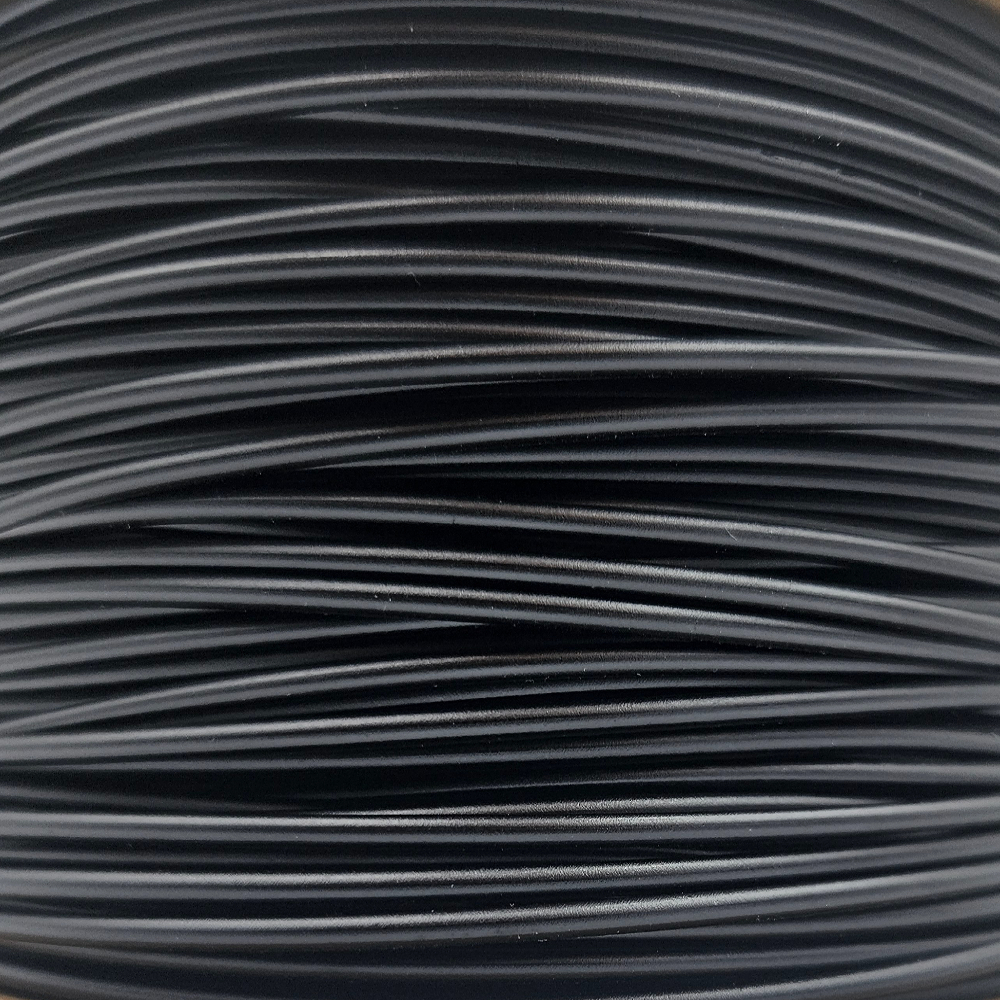
We formulate our PEKK-A/CNT Conductive Filament using PEKK [60/40 copolymer] and multi-wall carbon nanotubes (CNTs). As a result, it delivers aerospace-grade performance while remaining one of the most printable ultra polymers available. ABC3D’s conductive PEKK filament, furthermore, blends the inherent versatility of PEKK with reliable electrical conductivity through a CNT matrix, ensuring uniform static dissipation across printed parts.
Composite studies demonstrate that integrating carbon nanotubes into PEKK matrices significantly enhances electrical conductivity and structural performance without compromising thermal resistance, as shown in related research.
This specialty material empowers advanced 3D printing applications requiring durability, thermal stability, and electrostatic protection.
PEKK-A/CNT Grades and Applications
The Electrically Conductive PEKK Filament is available in three grades:
- Antistatic – with a volume resistivity of 10E8 to 10E10 ohm cm.
- Electrostatic Discharge Grade (ESD) – featuring a volume resistivity of 10E4 to 10E6 ohm cm.
- Conductive EMI/RFI Shielding – possessing a volume resistivity of 10E0 to 10E2 ohm cm.

Ideal for crafting circuits, sensors, and electromagnetic shielding, it offers boundless possibilities for various projects. In fact, whether you’re an electronics enthusiast, professional engineer, or creative maker, these filaments are your ultimate choice. Compatible with most standard 3D printers, they cater to a wide audience of makers, engineers, and designers. Printed objects feature a distinct matte finish with a lightly textured surface, enhancing both aesthetic appeal and functionality. Additionally, for increased precision, you can apply post-processing techniques like sanding or polishing while preserving electrical conductivity.
PEKK-A/CNT Conductive Applications:
- Circuits and sensors
- Static Dissipation
- Custom Connectors and Cables
- Anti-static Tools and Equipment
- Electronic Test Fixtures
- ESD Protection
- Automotive Sensors and Connectors
- Aerospace
- Robotics
- Wearable Technology
- Electronic Enclosures
- Repair and Maintenance
- Electrical Art and Sculptures
- Industrial Automation
Printer Specifications for PEKK-A/CNT
Nozzle Temp: 355-385°C
Bed Temp: 120-140°C
Nozzle Size: ≥ 0.4 mm minimum recommend hardened steel nozzle
Bed Prep: Nano Polymer Adhesive gives us the best results
Heated Chamber: Recommended, a chamber helps reduce warping and improves layer adhesion. 70-140°C if at all possible.
Supports: Water soluble support materials works ideal for complex parts
Drying Instructions: 120°C for 4 hours
ABC3D Quality for PEKK-A/CNT
We manufacture all our filaments with 5-axis laser-controlled precision to provide the highest class of products for the 3D printing industry.
Why Choose ABC3D for PEKK-A/CNT?
Our focus on industrial applications means you get more than just a spool of filament:
- Specialized Expertise: We are not a generic reseller; instead, we specialize in industrial-grade conductive filaments. You can learn more about our mission and engineering expertise.
- Canadian Quality: All our filaments are manufactured in Canada with rigorous quality control, ensuring a diameter tolerance of ±0.05mm and consistent CNT distribution.
- Aerospace-Grade Materials: This PEKK-A/CNT Conductive Filament is one of the most advanced polymers available, offering superior performance for certified applications in aerospace, defense, and automotive.
- Full Transparency: We provide downloadable technical data sheets (TDS) and material safety data sheets (MSDS) for all our products.
Technical Data Sheets for PEKK-A/CNT:
Coming Soon
Material Safety Data Sheet for PEKK-A/CNT:
Coming Soon
PEKK-A/CNT Conductive Filament: FAQs
1. Is this filament abrasive?
Yes. This is an extremely abrasive, high-performance composite. Consequently, a standard brass nozzle will be destroyed very quickly. A hardened steel, ruby-tipped, or all-metal nozzle is absolutely required.
2. How difficult is this PEKK-A/CNT filament to print?
This is an expert-level material. Because of this, it requires an industrial, high-temperature printer capable of reaching a 355-385°C nozzle temperature, a 120°C+ bed, and an actively heated chamber (70°C+). This filament cannot be printed on a standard desktop printer.
3. What is the difference between PEKK and PEEK?
PEKK and PEEK are in the same PAEK family; however, printers generally consider PEKK easier to print. Specifically, its [60/40 copolymer] formulation gives it a lower melting point and slower crystallization rate, which helps reduce warping and improve layer adhesion compared to PEEK.
4. Why use PEKK-A/CNT over PEI 9085/CNT?
PEKK-A/CNT generally offers superior mechanical properties, fatigue resistance, and chemical resistance compared to PEI. While PEI 9085 is an excellent, certified material (UL 94 V-0), engineers often choose PEKK for the most demanding structural parts that face extreme mechanical stress and harsh chemicals.
Reviews
There are no reviews yet.