
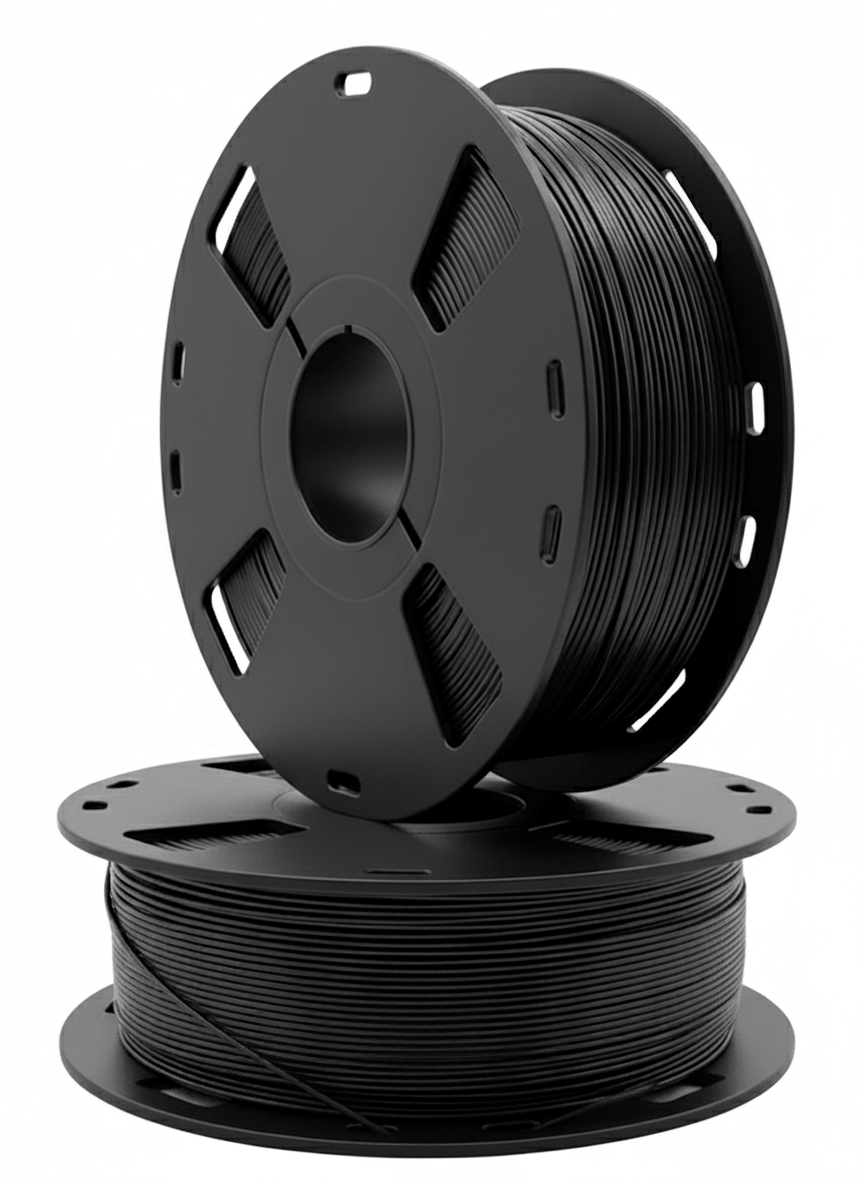
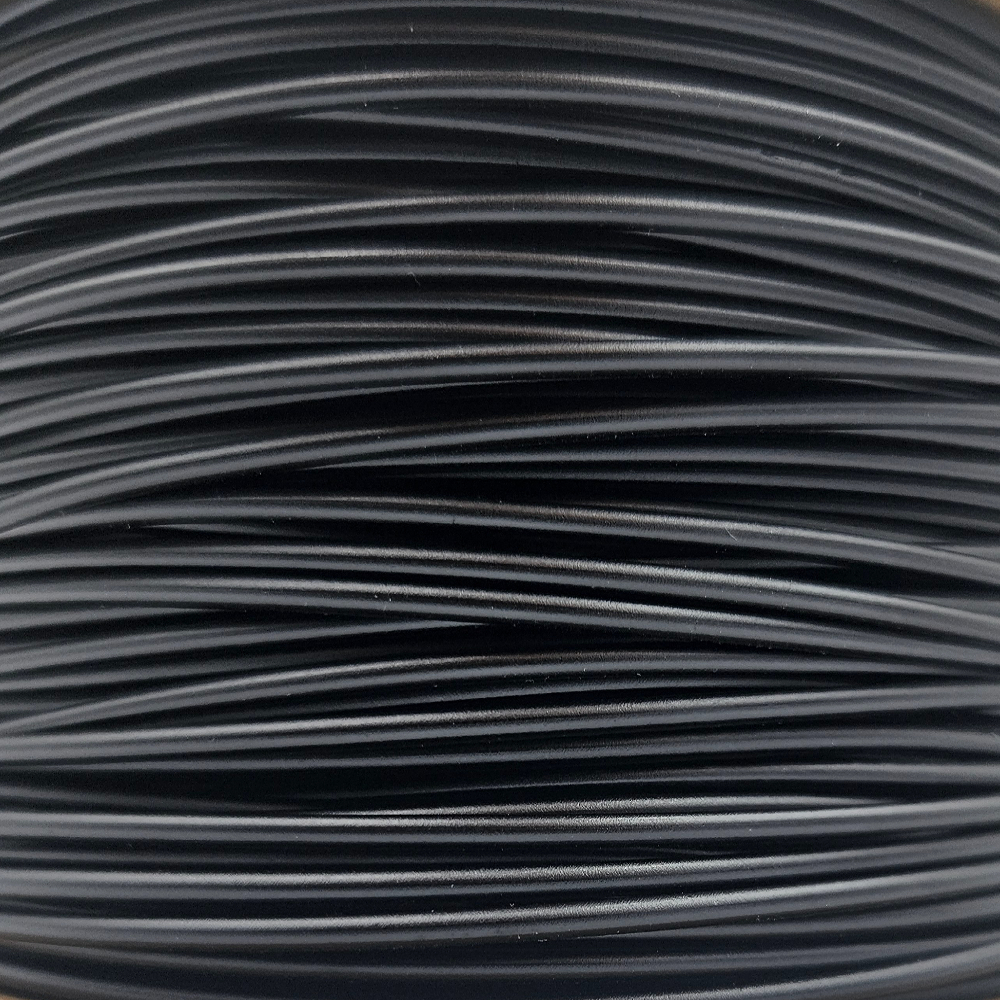
ABC3D’s ABS/CNT Conductive Filament is a reliable solution for static control in industrial 3D printing, offered in three distinct conductivity grades: Antistatic, ESD, and EMI/RFI Shielding. By engineering this filament with Carbon Nanotube (CNT) technology, we ensure consistent conductivity and great mechanical strength. Consequently, it’s perfect for both functional prototypes and final production parts.
Recent research has demonstrated that CNT-enhanced ABS filaments provide stable printability and tunable conductivity through well-formed nanotube networks, enabling structurally robust conductive parts suitable for demanding industrial use (Podsiadły et al., 2021).
Based on the robust and versatile ABS polymer, this material also offers excellent toughness and thermal stability. This means parts printed with our ABS/CNT Conductive Filament are not only electrically functional but also durable enough for end-use applications, including jigs, fixtures, and custom electronic enclosures.
Three Grades for Every Application:
- Antistatic – with a volume resistivity of 10E8 to 10E10 ohm cm.
- Electrostatic Discharge Grade (ESD) – featuring a volume resistivity of 10E4 to 10E6 ohm cm.
- Conductive EMI/RFI Shielding – possessing a volume resistivity of 10E0 to 10E2 ohm cm.

Thanks to its unique properties, this filament is ideal for making circuits, sensors, and electromagnetic shielding, which opens up boundless project possibilities. In fact, it’s an excellent choice for a wide range of users, from electronics enthusiasts to professional engineers. Another key benefit is its compatibility with most standard 3D printers, making our ABS/CNT Conductive Filament highly accessible. As a bonus, printed objects feature a distinct matte finish, enhancing both their appearance and functionality.
Applications:
- Circuits and sensors
- Durable ESD-safe jigs and fixtures
- Tough, impact-resistant electronic enclosures
- EMI/RFI shielding for functional prototypes
- Antistatic components for industrial automation
- Custom cases and mounts for sensitive electronics
Printer Specifications
Nozzle Temperature: 240°C – 270°C
Bed Temperature: 90°C – 110°C (An enclosure is highly recommended)
Nozzle Type: Hardened steel (0.4mm or larger) is required. This filament is abrasive due to the CNT content and will wear down brass nozzles.
Bed Adhesion: A PEI sheet or ABS slurry on a glass bed is recommended to prevent warping.
Enclosure: An enclosure is required. Printing ABS in an enclosed, warm environment is critical to prevent layer splitting and warping.
Filament Drying: Yes. ABS is hygroscopic. Dry at 70°C – 80°C for at least 4-6 hours before printing for best results.
Quality
We make all our filaments with 5-Axis laser-controlled precision, providing the highest class of products for the 3D printing industry.
Why Choose ABC3D?
Our focus on industrial applications means you get more than just a spool of filament:
- Specialized Expertise: We are not a generic reseller; instead, we specialize in industrial-grade conductive filaments. You can learn more about our mission and engineering expertise.
- Canadian Quality: All our filaments are manufactured in Canada with rigorous quality control, ensuring a diameter tolerance of ±0.05mm and consistent CNT distribution.
- High-Performance Materials: This ABS/CNT blend is designed for functional, end-use parts that require thermal stability and toughness.
- Full Transparency: We provide downloadable technical data sheets (TDS) and material safety data sheets (MSDS) for all our products.
Technical Data Sheets:
Antistatic Grade
Electrostatic Discharge (ESD) Grade
Conductive EMI/RFI Shielding Grade (Request Access) 🔒
Material Safety Data Sheet:
Frequently Asked Questions
1. Do I absolutely need an enclosure to print this?
Yes. Printing ABS without an enclosure is extremely difficult, primarily because the material will warp and split between layers as it cools unevenly. As a result, a heated chamber or enclosure is critical for maintaining a stable, high ambient temperature for successful ABS printing.
2. Does this filament smell when printing?
Yes. Like all ABS filaments, this material will produce strong fumes and Volatile Organic Compounds (VOCs) when printed. Therefore, you must print in a well-ventilated area, and we highly recommend using an enclosure with a carbon filter or an external vent.
3. How does this compare to your PLA/CNT and PETG/CNT filaments?
ABS/CNT is the toughest and most temperature-resistant of the three. Choose PLA/CNT for ease of printing and prototyping. Choose PETG/CNT for a balance of durability and chemical resistance. Finally, choose ABS/CNT for functional, end-use parts that need to withstand impacts or higher operating temperatures (up to ~90-100°C).
4. Is this filament abrasive?
Yes. The Carbon Nanotube (CNT) content makes this filament abrasive. Consequently, it will wear down a standard brass nozzle quickly. For this reason, we require the use of a hardened steel, ruby-tipped, or other abrasive-resistant nozzle to ensure a consistent extrusion width.
Reviews
There are no reviews yet.