
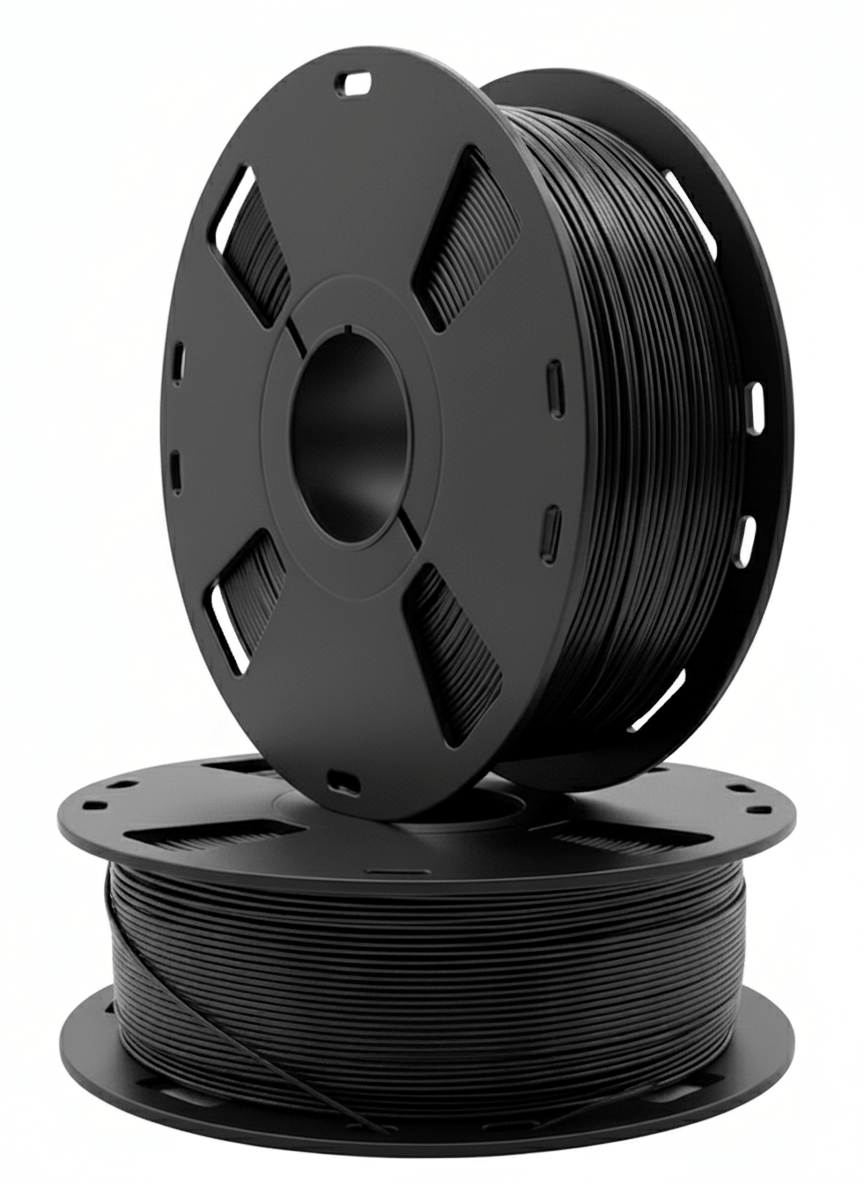
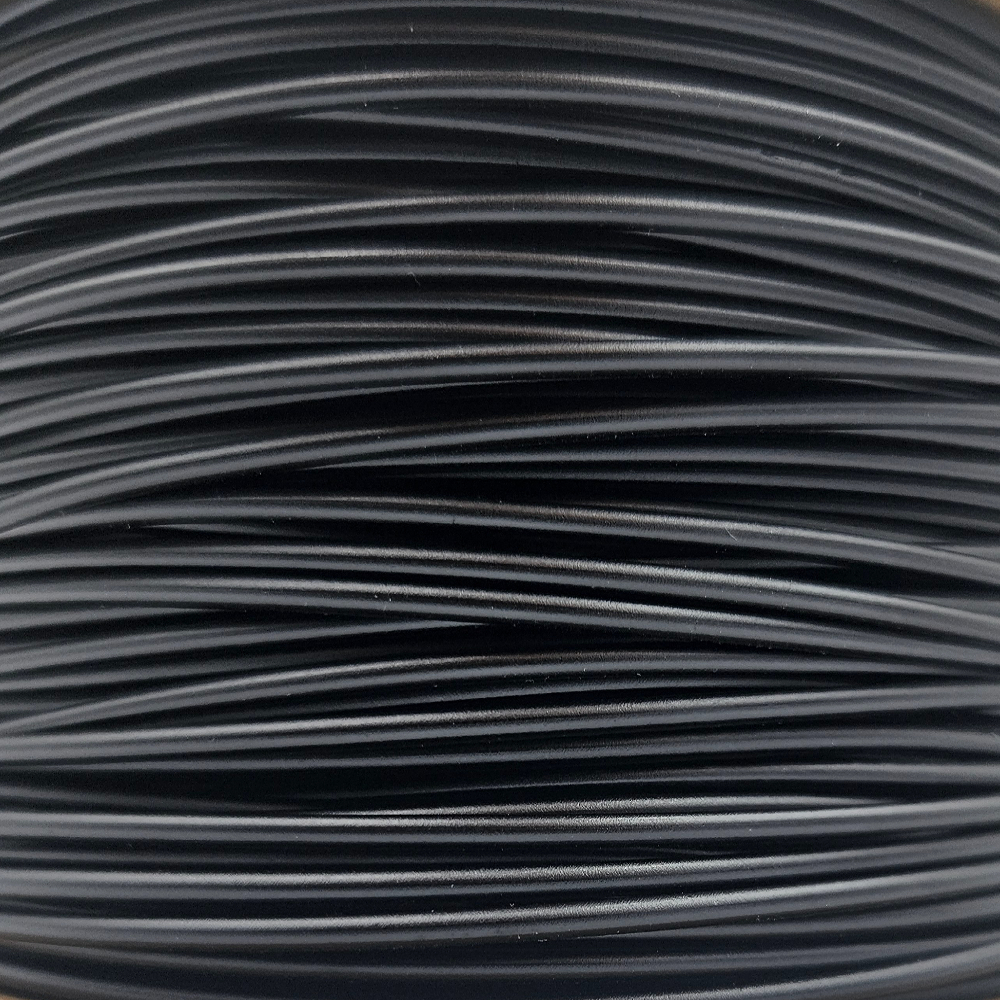
ABC3D’s PETG/CNT Conductive Filament offers a fantastic combination of PETG’s well-known durability and chemical resistance with the electrostatic performance of carbon nanotubes. As a result, you get a user-friendly, moisture-resistant filament with stable and reliable electrical conductivity. We’ve ensured that PETG’s great dimensional accuracy and layer adhesion are preserved, while the embedded CNT matrix provides effective ESD-safe behavior, as confirmed in studies like Mahmoodi et al., 2012.
To meet your specific technical needs, our PETG/CNT Conductive Filament is available in three grades:
- Antistatic – with a volume resistivity of 10E8 to 10E10 ohm cm.
- Electrostatic Discharge Grade (ESD) – featuring a volume resistivity of 10E4 to 10E6 ohm cm.
- Conductive EMI/RFI Shielding – possessing a volume resistivity of 10E0 to 10E2 ohm cm.

Because of these properties, the filament is perfect for creating durable electronic enclosures, custom jigs, and fixtures that require static protection. Additionally, its excellent chemical resistance makes it a great choice for automotive and industrial applications. Perhaps the biggest benefit, however, is the ease of use that this conductive PETG provides, making it highly accessible to a wide audience. Finally, printed objects feature a clean matte finish that improves both their look and performance.
Applications:
- Durable ESD-safe enclosures for electronics
- Chemically-resistant jigs and fixtures for industrial use
- Static-dissipative components for automotive applications
- EMI/RFI shielding for IoT sensors and devices
- Robotics and drone components requiring durability
- Anti-static tools and custom connectors
Printer Specifications
Nozzle Temperature: 230°C – 250°C
Bed Temperature: 70°C – 85°C
Nozzle Type: Hardened steel (0.4mm or larger) is required. This filament is abrasive due to the CNT content and will wear down brass nozzles.
Print Speed: 40-60 mm/s
Bed Adhesion: A PEI sheet or a clean glass bed with a glue stick layer is highly recommended.
Filament Drying: PETG is extremely hygroscopic. You must dry this filament at 60°C – 65°C for at least 4-8 hours before printing to prevent stringing and ensure part quality.
Quality
All our filaments are made with 5-Axis laser-controlled precision, providing the highest class of products for the 3D printing industry.
Why Choose ABC3D?
Our focus on industrial applications means you get more than just a spool of filament:
- Specialized Expertise: We are not a generic reseller; instead, we specialize in industrial-grade conductive filaments. You can learn more about our mission and engineering expertise.
- Canadian Quality: All our filaments are manufactured in Canada with rigorous quality control, ensuring a diameter tolerance of ±0.05mm and consistent CNT distribution.
- Industrial Grade Materials: This PETG/CNT blend is designed for real-world industrial use, focusing on durability and chemical resistance.
- Full Transparency: We provide downloadable technical data sheets (TDS) and material safety data sheets (MSDS) for all our products.
Technical Data Sheets:
Antistatic Grade
Electrostatic Discharge (ESD) Grade
Conductive EMI/RFI Shielding Grade (Request Access) 🔒
Material Safety Data Sheet:
Material Safety Data Sheet (MSDS)
Frequently Asked Questions
1. Is this PETG/CNT filament abrasive?
Yes. Just like our PLA/CNT, this filament is abrasive due to the Carbon Nanotube (CNT) content. Consequently, it will wear down a standard brass nozzle very quickly. We require the use of a hardened steel, ruby-tipped, or other abrasive-resistant nozzle.
2. How is this different from PETG Carbon Fiber filament?
This is a common question. PETG Carbon Fiber uses *chopped carbon fibers* for structural reinforcement—to make parts stiffer, stronger, and more heat-resistant. This PETG/CNT filament, however, uses *Carbon Nanotubes* for electrical conductivity. Its primary purpose is ESD protection and EMI shielding, not structural strength.
3. Why does my print look stringy?
Stringing with PETG is almost always a moisture issue. PETG absorbs moisture from the air much faster than PLA. Therefore, you must dry the spool at 60°C-65°C for 4-8 hours before printing, even if it’s new. Storing it in a dry box is also highly recommended.
4. Can I print this on an open-frame printer (e.g., Ender 3)?
Yes. While an enclosure can help with layer adhesion on large parts, PETG/CNT does not warp as much as ABS and can be printed successfully on an open-frame printer, provided you have a reliable heated bed (70°C+).
Reviews
There are no reviews yet.