
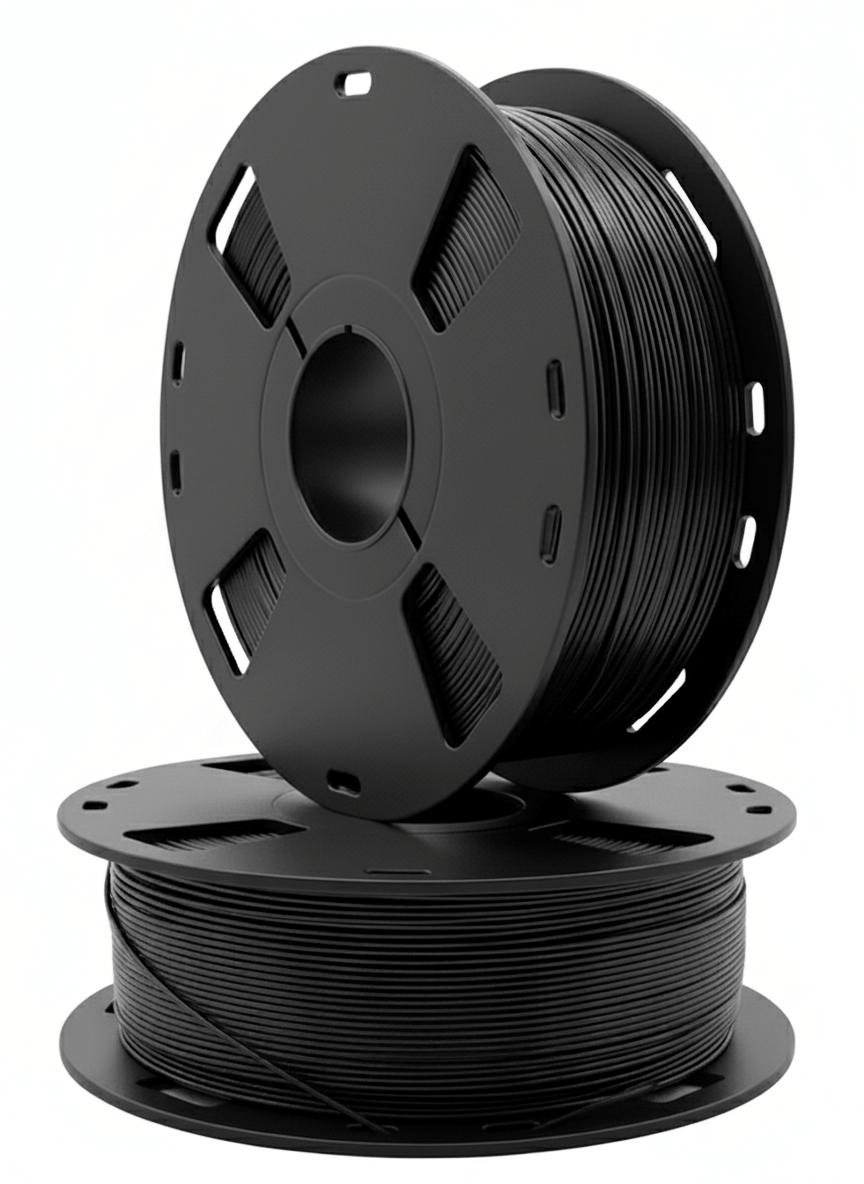
Our TPU/CNT Conductive Filament combines the amazing flexibility of an elastomer with reliable electrical conductivity, making it perfect for dynamic and wearable electronics. We’ve engineered this filament to merge the versatility of TPU with special electrical properties, helping you bring innovative ideas to life. In fact, the embedded Carbon Nanotube (CNT) matrix provides stable ESD performance without sacrificing the high elongation and tear resistance TPU is known for. As noted in research like Arjmand et al., 2011, CNTs are proven to enhance conductive performance in elastomer matrices.
To suit your project’s specific needs, this electrically conductive TPU filament is available in three grades:
- Antistatic – with a volume resistivity of 10E8 to 10E10 ohm cm.
- Electrostatic Discharge Grade (ESD) – featuring a volume resistivity of 10E4 to 10E6 ohm cm.
- Conductive EMI/RFI Shielding – possessing a volume resistivity of 10E0 to 10E2 ohm cm.

Therefore, this material is perfect for creating flexible circuits, wearable sensors, and custom conductive gaskets. Because it can bend and stretch, our TPU/CNT Conductive Filament opens up possibilities that are impossible with rigid materials. It’s an excellent choice for robotics, soft electronics, and prototyping, and since it’s compatible with most standard 3D printers, it’s accessible to a wide audience. Additionally, printed objects feature a clean matte finish, improving both their look and performance.
Applications:
- Circuits and sensors
- Static Dissipation
- Custom Connectors and Cables
- Anti-static Tools and Equipment
- Electronic Test Fixtures
- ESD Protection
- Automotive Sensors and Connectors
- Aerospace
- Robotics
- Wearable Technology
- Electronic Enclosures
- Repair and Maintenance
- Electrical Art and Sculptures
- Industrial Automation
Printer Specifications
Nozzle Temp: 220 – 240 °C
Bed Temp: 40-60°C
Bed Prep: Hairspray, Glue Stick, Polyimide surface
Heated Chamber: Not Required
Supports: Water soluble support materials works ideal for complex parts
Drying Instructions: 65°C for 4 hours (TPU is very hygroscopic)
Quality
All filaments are manufactured with 5-Axis laser-controlled precision providing the highest class of products for the 3D printing industry.
Why Choose ABC3D?
Our focus on industrial applications means you get more than just a spool of filament:
- Specialized Expertise: We are not a generic reseller; instead, we specialize in industrial-grade conductive filaments. You can learn more about our mission and engineering expertise.
- Canadian Quality: All our filaments are manufactured in Canada with rigorous quality control, ensuring a diameter tolerance of ±0.05mm and consistent CNT distribution.
- High-Performance Materials: This TPU/CNT Conductive Filament is designed for functional, flexible parts that require durability and reliable ESD protection.
- Full Transparency: We provide downloadable technical data sheets (TDS) and material safety data sheets (MSDS) for all our products.
Technical Data Sheets:
Coming Soon
Material Safety Data Sheet:
Material Safety Data Sheet (MSDS) for TPU/CNT
Frequently Asked Questions
1. Is this filament abrasive?
Yes. The Carbon Nanotube (CNT) content makes this filament abrasive. Consequently, it will wear down a standard brass nozzle quickly. We require the use of a hardened steel, ruby-tipped, or other abrasive-resistant nozzle to ensure a consistent extrusion width.
2. How hard is it to print flexible conductive filament?
If you have printed standard TPU, you will find this very similar. However, printing flexibles requires a direct-drive extruder for best results. Bowden extruders may struggle. In addition, you must print slowly (20-40 mm/s) and disable retraction to prevent clogging.
3. How flexible is this filament?
This TPU/CNT Conductive Filament has a Shore hardness of 90A. This is a “semi-flexible” material, similar to the sole of a running shoe. It is not “gummy” like a rubber band but is extremely durable and will bend and stretch significantly before breaking.
4. Does stretching the part change its conductivity?
Yes. The electrical resistance of the part will increase as it is stretched, because the conductive CNT particles are being pulled further apart. The part will return to its original resistance when it returns to its resting state. This property is often used to create flexible sensors.
Reviews
There are no reviews yet.